

Bespoke horse-powered wildflower meadow management

From inner city parks to inaccessible forest glades, every meadow we manage is different. Before creating a management plan for wildflower meadows, hay meadows or conservation grasslands, we take into account the locality of the meadow, what grows in in it and what lives in it; when it should be cut, how it should be cut and what other management techniques might be appropriate. We don’t only bring the horse-power, we have the knowledge and experience to consult on best practices for wildflower meadow management for every unique situation.
In 2025, we tended just under 300 acres of meadows across the South East and London, and expanded our range of services to include seed collection and baling, making us the first business of our kind in the UK to offer a fully horse-powered wildflower meadow management package.
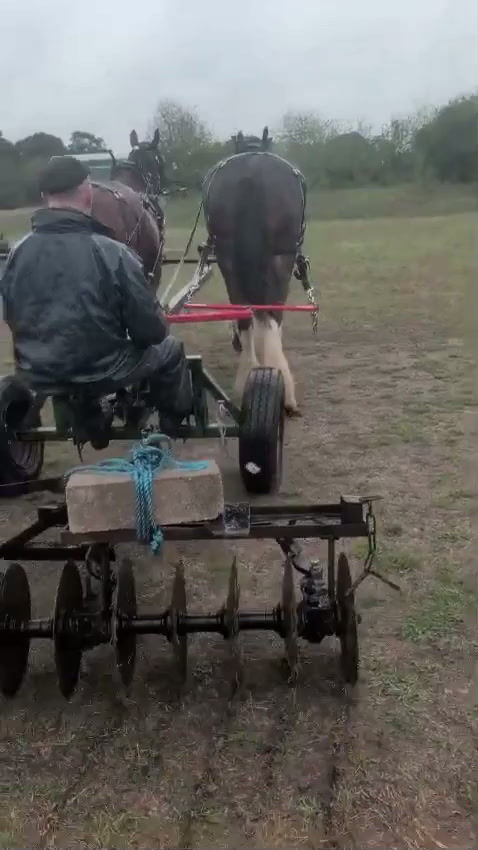
Meadow preparation: Horse-drawn disc harrow
Meadows often build up thick layers of dead grass and roots (thatch). The rolling blades of a disc harrow slice through this layer, allowing air, water, and seeds to reach the actual soil.
Our horse-drawn disc harrow is a highly valuable, low-impact tool for meadow preparation, restoration, and overseeding. Heavy tractors pack down the soil, destroying root channels and reducing water infiltration. The significantly lighter footprint of horses paired with a compact disc harrow prevents compaction, keeping the meadow soil spongy and healthy.,
Our horse-drawn disc harrow excels at slicing through the sod - the first step in preparing the seed bed for wildflower and grass meadows.
Meadow preparation: Horse-drawn spring-tyned cultivator
For the next stage of meadow preparation, we use a horse-drawn spring-tyned harrow to tear up the top two to three inches of soil.
The flexible tynes vibrate rapidly to stir up the top layer of earth, creating a loose, finely aerated seedbed that improves water absorption without overturning the deeper soil layers. Relying on horsepower, rather than heavy tractor-driven machinery, it is effective on the most compacted of soils (like the sports field in the video opposite).


Sowing the meadow
We sow the seed on foot using our trusted Shandy Barrow. This allows seed to be distributed evenly and efficiently, helping to achieve consistent coverage. It also reduces waste caused by uneven application.
Horse-drawn chain harrow
We use the chain harrow to aerate the soil and improve nutrient absorption. The process clears dead grass, gently breaks up the earth and disturbs the top layer of soil – allowing new wildflower and grass seeds to germinate and thrive.


Horse-drawn wildflower seed collection
Harvesting wildflower seeds before cutting prevents seed loss during mowing, preserves locally adapted wildflower populations, supports habitat restoration in degraded areas and improves species richness. We have designed a bespoke horse-drawn seed collector – the first of its kind in the UK. Fully adjustable to suit varying stem heights, offset to the horses so that we don’t trample the plants we are harvesting, and featuring a very gentle mechanism to ensure wildlife is left unharmed, it is a game changer for wildflower meadow management.
By combining horse-drawn seed collection with our full suite of services, Oakwood Clydesdales is the first UK business to offer a complete horse-powered wildflower meadow management package.
Horse-drawn meadow mowing
Our horse-drawn mower is much lighter than conventional tractors, with a much smaller load-bearing footprint to minimise soil compaction. The adjustable cutting bar allows for higher ground clearance if required, protecting ground-nesting wildlife and sensitive habitats at the base of the grass.
The mechanism of the mower is land driven – the motion of the horses powers the cutting mechanism, which mean no engines and no fossil fuels are required. This cuts emissions and noise pollution, and eliminates the risk of oil spills. We also travel at a low speed, ensuring a clean, even cut.

Horse-drawn raking
Our light-horse-drawn rake turns and rows cut hay prior to baling. Ideal for species-rich hay meadows and wildflower meadows, it doesn’t damage sensitive habitats or disturb wildlife – unlike heavier machinery.


Horse-drawn baling
The key to providing a comprehensive range of horse powered conservation services is to not only diversify traditional agricultural methods, but also look at how modern technology can be applied. We now offer a horse-drawn baling service as part of our conservation service portfolio. This means that tractors are no longer required at any stage of the meadow management process – a UK first.